Wednesday, August 21, 2019
At It Again
Wednesday, November 16, 2016
Metaphors and Similes
But here's one thing I don't understand: why does anyone care about the difference between a metaphor and a simile?
Yes, I had to learn the definitions in school to pass tests, but in all my years as a writer and reader I've never needed to know that information.
Sometimes I use and read comparisons using the words, like, or as, and sometimes I use and read comparisons that don't use those words.
So what?
The meaning is clear either way.
Lots of things - maybe even most things - I learned about grammar in school are useful to know, but the difference between a metaphor and a simile is one thing I consider a waste of time to teach.
Who cares?
Wednesday, October 19, 2016
Imagination
She didn't mean it as a compliment, but I'm happy to have an active imagination.
My neighborhood friends and I used to pretend to be all sorts of things while we played outside. At times I was a princess, a horse, a space alien, etc., etc., etc.
Unfortunately, today lots of kids stop pretending when they're young because they always have adults supervising them. Sometimes the only way they use their imaginations is with video games.
But I still have an active imagination, which is one reason why I write books for kids. And when children - or grown-ups - get involved in good books they're carried away to adventures and different worlds and experiences.
Some of my books include ordinary kids taking risks to reach important goals. One is about an imaginary creature - a giant talking worm. Another book takes readers to the past, and one helps them understand people who are different from themselves.
I believe providing fiction for kids to read is an important task.
What else can we do to help kids use and develop their imaginations?
(P.S if you want to know more about my books go to my website, www.janetanncollins.com)
Saturday, June 25, 2016
My First Book
Those letters stood for the phrase, What Would Jesus Do?
At the time I was a substitute teacher and sometimes worked with kids in Middle School. I wondered how Jesus might have acted if he'd been a kid in an environment like that.
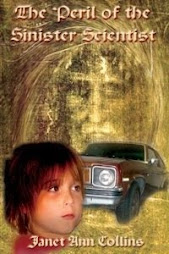
Later that question inspired me to write my first published book, The Peril of the Sinister Scientist.
It's about a boy in Middle School who wants to act like Jesus.
I needed a strong motivation for him, and thought of one: the boy thinks he might be a clone of Jesus Christ because a scientist who worked on an experiment to clone Jesus is stalking him.
The book is with a small publishing house, and the publisher hurried it into publication ahead of schedule so I would be able to participate in a group book signing. Unfortunately, because of the rush, the kid on the cover doesn't look like the main character in the book.
The book was published in 2009 but it's still available on Amazon
(Here's the link: http://tinyurl.com/hbdhtuu ) and bookstores can order it through their distributors.
Here's what the cover looks like:
Wednesday, May 1, 2013
Why I Read Them
Okay, here are the reasons:
1. I write books for kids.
2. I can usually finish a middle grade and sometimes a YA novel in an hour or two and don't have to put it down in the middle of a story.
3. YA books are usually not offensive or depressing.
4. Okay, here's the real reason: I'm still really a kid on the inside and hope I never grow up.
Of course I sometimes read books for grown-ups, too, but those are mostly non-fiction and I read them for practical reasons.
Saturday, June 9, 2012
What If....?
Today plastic and synthetics are everywhere. What would happen if they were all to suddenly disappear? Insulation on wires would be gone so fires would start, cars would fall apart on the roads, and many people would find themselves naked as their clothing evaporated.
If you're a writer, or would like to be one, think of a story involving that horrific event. What could have caused it? How would people react? And what could be done about the resulting problems?
I'd love to hear your ideas.
Saturday, February 4, 2012
Becoming a Writer
Recently someone asked me to explain how I became a writer, so here’s the story.
From early childhood I wanted to be an author and majored in English in college. I carefully wrote every assignment in my first English class according to the Thesis Sentence Outline that had been drilled into us in high school.
One day the professor asked what I wanted to do after graduation. When I told him my goal to be a writer he replied, “You’ll never make it. You have no creativity.”
Foolishly I believed him and gave up the dream of getting published, although I never stopped writing. But no other career seemed right so I still told people I wanted to be a writer.
My roommate said, “Show me your rejection slips. You’re not a writer unless you have rejection slips.” To stop her nagging, I sent something to a publication where I knew it couldn’t possibly be accepted, showed her the rejection slip, and she left me alone.
One day about 25 years later I remembered the professor’s words and realized following that outline had made my writing uncreative. I wrote a children’s story I had often told my kids, submitted it to two possible publishers, and it was accepted by one of them.
“That was easy,” I thought.
I typed out something else, sent it off, and got the first of many rejections. That showed I was really a writer!
Realizing I needed to learn the craft, I read books, subscribed to magazines, attended conferences and joined a critique group. As with any other profession, there was a lot to learn.
Since then I’ve lost count of how many things I’ve had published in periodicals, and I’m now the author of three books for kids. A fourth one, Slime and All, will be published this month.
Wednesday, October 5, 2011
Oxygen
Wednesday, July 20, 2011
11 Secrets of Getting Published
I've met Mary DeMuth at writers conferences and was pleased to get a free copy of her e-book, 11 Secrets of Getting Published. I've always admired Mary for her courageous vulnerability and willingness to help others and those qualities show as she reveals her own mistakes along the way. Wednesday, September 29, 2010
The Slippery Art of Book Reviewing
Wednesday, October 7, 2009
Folk Song for Writers
Advice
by
Janet Ann Collins
( To the tune of Get Along Home, Cindy)
“I’d like to write some novels
And stories, books, and rhymes.
I want to write some articles
And sell them every time.”
“Sit down and write,
Then you mend ‘em.
Sit down and write,” I say.
“Sit down and write,
Mend ‘em, send ’em.
That’s how you’ll sell someday.”
Saturday, September 12, 2009
Author Questions
Cheryl Malandrinos tagged me! That means that I have to play tag by answering a few little interview questions! Then I have to blog tag someone else! So, here are my answers and here are the bloggers I am tagging! I guess I’m it!
1. Which words do you use too much in your writing?
Suddenly, just and the verb to be. I was just amazed when my editor suddenly asked me to remove most of them from my manuscript.
2. Which words do you consider overused in stuff you read?
To tell the truth, I seldom notice the words when I’m reading. They’re like a transparent window that lets me view the fictional universe of the story.
3. What are your other favorite blogs?
http://relevantblog.blogspot.com/
http://www.janetperezeckles.com/blog.html
and http://www.advancedfictionwriting.com/blog/
http://www.soccermombook.com/blog/
to name just a few.
4. Name a favorite word:
Acceptance. I love getting those from publishers.
5. And a word you’re not so keen on:
Rejection. Getting those proves I’m a writer, but it doesn’t make me like them.
6. What would you like to improve about your writing and/or blog?
I’d like my words to be so fascinating people would be flocking to read them.
7. What’s your writing ambition?
Seriously, I would like at least a few people to have their lives changed for the better because of reading things I write.
I now blog tag the following blogs / bloggers:
http://billkirkwrites.blogspot.com/
http://jessicakennedy71.blogspot.com