Wednesday, October 21, 2009

Tiny Angel

I recently had the privilege of reading a soon-to-be-published book by Nancy Carty Lepri called Tiny Angel.
It was bad enough that Macy had to move away from her best friend, whose letters showed she had quickly found another best friend.
Attending school in a new town where she had no friends at all and became a victim of the class bully was worse. And it didn't help that her teacher was pushing her to participate in a major spelling bee, which would make her seem like a nerd to everyone.
To top it all off, the tiny angel who unexpectedly showed up might turn out to be more of a problem than a help.
How could Macy ever make some friends and have a normal life?
Kids can easily identify with Macy's troubles and the touch of supernatural influence makes Tiny Angel more than just another book about problems in school. I think young readers will love this book.

Saturday, October 17, 2009

Skeletons

No Bones About It is one of The Sum of Our Parts series by Bill Kirk. These books teach kids about their bodies in a fun way.
Since it's a picture book, my first impression was that this book was for little kids, but it contains fascinating scientific information that will interest older ones. It certainly was interesting to me, and I'm a grown up. The amusing rhymes on each page will entertain kids of all ages, though the younger ones probably won't understand the vocabulary. The fascinating factoids are definitely for the older set and the book is intended for eight to thirteen year olds.
The illustrations are by the talented Eugene Ruble who also did the artwork for my soon-to-be-released book, Secret Service Saint and many others. Ruble does an excellent job of drawing the skeletal parts accurately while keeping the pictures amusing.
No Bones About It will be helpful to young students for educational purposes, but it's also just plain fun.
I expect the other books in the series will be equally enjoyable.

Wednesday, October 14, 2009

Where Does Food Come From?

After the Special Ed class where I had worked as a substitute teacher was over for the day I went to help the afternoon Kindergarten teacher. Her class was digging up the carrots they had planted earlier in the year and the children were thrilled and amazed to see what their seeds had produced. Even those who didn't like vegetables were eager to taste the carrots they had grown themselves.
I've also seen children eagerly devour food they helped to cook even if was something didn't normally like.
We all know childhood obesity is a problem, but eating healthier foods can help with that. In our American society where both parents (or the only parent) must work at jobs away from home fewer families eat food made from scratch. Heating up something from the freezer saves valuable time and fast foods are called that for a good reason.
But we don't have to eat quickly every day. Cooking together is a good way to have family together time and growing even a few edible plants in flower pots helps kids learn.
Of course hot stoves and sharp knives are dangerous for little children, but even if someone else must do the chopping or put things on and off of the burner kids can do a lot to help prepare meals. Doing that may encourage them to eat healthy foods and can also increase their confidence.

Saturday, October 10, 2009

Case of the Missing Sock

Renee Hand's book, The Case of the Missing Sock, is a delightful mystery for kids. It's part of the Crypto-Capers series about a group of children and a granny who are gifted with abilities that allow them to solve mysteries. The gifts are not supernatural, just unusually strong talents and intelligence.
It was fun to watch the characters unravel the clues and young readers will enjoy figuring out the cryptological messages left by the thief for what turns out to be a believable reason.
Although this book is second in a series and some references to earlier events are not explained in detail, it stands alone comfortably.
However there is one problem with it. The publishing house, North Star Press, is in need of a good copy editor. The dozens of errors, such as misused homonyms, were annoying and pulled me out of the story. But, unlike a college English major like me, most kids who read the book probably won't even notice the mistakes and will simply enjoy the mystery.

Wednesday, October 7, 2009

Folk Song for Writers

Would you like to be a professional writer? If so, you might be interested in something I wrote many years ago. It's a little bit silly, but true.

Advice

by

Janet Ann Collins

( To the tune of Get Along Home, Cindy)

“I’d like to write some novels

And stories, books, and rhymes.

I want to write some articles

And sell them every time.”

“Sit down and write,

Then you mend ‘em.

Sit down and write,” I say.

“Sit down and write,

Mend ‘em, send ’em.

That’s how you’ll sell someday.”

Monday, October 5, 2009

Shroud of Turin

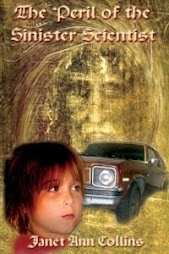
A story about the Shroud of Turin is in the news today. A scientist named Luigi Garlaschelli is supposed to have shown that the Shroud isn't real. Maybe I should send him a copy of my book, The Peril of the Sinister Scientist, which is about a kid who thinks he was cloned from the blood on the Shroud of Turin because a scientist who worked on that experiment is stalking him.
Nah. Even if he speaks English he probably wouldn't want to read a fiction book. And, anyway, I don't know how to contact him.

Saturday, October 3, 2009

What to Eat

My mother used to insist we eat our "Good red meat" first because back in the 1940s everyone 'knew' that was the healthiest food. Of course now we know it's high in bad cholesterol and not good for us.
There used to be seven basic food groups that everyone was supposed to eat every day. Let's see if I can remember what they were. Protein foods, green vegetables, yellow, and orange vegetables, fruits, dairy foods (which included eggs,) and carbohydrate foods are all I can think of. That list was replaced by five basic foods and now there's a food pyramid. Who knows what basic food lists will be created in the future?
Of course there are lots of other ways some people think we should eat in order to be healthy including the Cave Man, vegetarian, and vegan diets.
So how should we feed our kids?
While we don't all agree on the best way to eat, we do know obesity is unhealthy and has caused lots of people to have serious health problems. Most people agree that a lot of fast food is unhealthy, but busy people often don't think they have time to cook from scratch.
My advice is to listen to Aristotle and have moderation in all things. Unless there's a medical reason to avoid certain foods, we should be sure our children get as varied a diet as possible and try not to overdo any one kind of food.